The following example computes per-pixel lighting (only the diffuse contribution is computed) on a sub-scene graph. Per-pixel lighting gives better lighting quality than per-vertex lighting (with classical OpenGL pipeline) because the light contributions are computed at each pixel instead of at each vertex.
The original example (located in $OIVHOME/src/Inventor/examples/Features/Shaders/PixelLighting), enables you to select when the application starts the shading language used for the per-pixel lighting.
The example described below, includes only the essential part of the complete source.
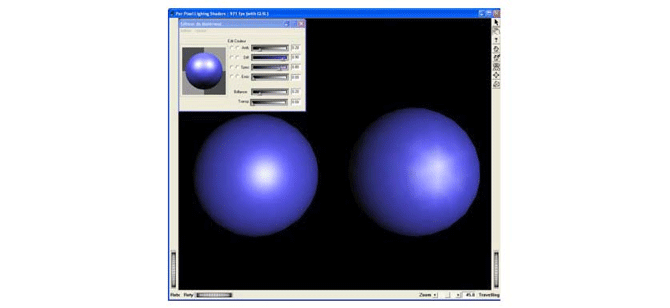
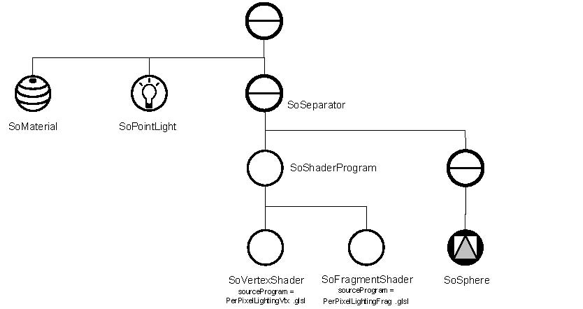
Example 21.1. Writing a per-pixel shader
Contents of PixelLighting.cxx
void configureShaders()
{
  // Initialize and set the vertex shader
  VertexShader = new SoVertexShader;

  // Initialize and set the fragment shader
  FragmentShader = new SoFragmentShader;

  // Specify the vertex and fragment shaders
  VertexShader->
  sourceProgram.setValue("../../../data/Shaders/PixelLightingVtx.glsl");
  FragmentShader->
  sourceProgram.setValue("../../../data/Shaders/PixelLightingFrag.glsl");

  // Initialize and set the shader program
  SoShaderProgram *shaderProgram = new SoShaderProgram;
  shaderProgram->shaderObject.set1Value(0, VertexShader);
  shaderProgram->shaderObject.set1Value(1, FragmentShader);

  // Add the shader program to the separator
  ShaderSep->insertChild(shaderProgram, 0);
}

int main(int argc, char **argv)
{
  ...
  SoSeparator *root = new SoSeparator;
  root->ref();

  // Point light
  PointLight = new SoPointLightManip;

  ShaderSep = new SoSeparator;

  SoSeparator *sphereSep = new SoSeparator;
  sphereSep->addChild(new SoSphere);

  // Configures the shader
  configureShaders();

  // Add the sphere to the shaders' separator to apply the shaders to it.
  ShaderSep->addChild(sphereSep);

  // Material applied to the model
  SoMaterial *modelMat = new SoMaterial;
  modelMat->ambientColor.setValue(0.2f, 0.2f, 0.2f);
  modelMat->diffuseColor.setValue(0.3f, 0.3f, 0.9f);
  modelMat->specularColor.setValue(0.6f, 0.6f, 0.8f);
  modelMat->emissiveColor.setValue(0.0f, 0.0f, 0.0f);
  modelMat->shininess.setValue(0.2f);

  // Build the scene graph
  root->addChild(modelMat);
  root->addChild(PointLight);
  root->addChild(ShaderSep);
  ...
}
void ConfigureShaders()
{
  // Initialize and set the vertex shader
  SoVertexShader VertexShader = new SoVertexShader();

  // Initialize and set the fragment shader
  SoFragmentShader FragmentShader = new SoFragmentShader();

  // Specify the vertex and fragment shaders
  VertexShader.sourceProgram.Value =
      "$OIVNETHOME/src/Inventor/examples/data/Shaders/PixelLightingVtx.glsl";
  FragmentShader.sourceProgram.Value =
      "$OIVNETHOME/src/Inventor/examples/data/Shaders/PixelLightingFrag.glsl";

  // Initialize and set the shader program
  SoShaderProgram shaderProgram = new SoShaderProgram();
  shaderProgram.shaderObject[0] = VertexShader;
  shaderProgram.shaderObject[1] = FragmentShader;

  // Add the shader program to the separator
  ShaderSep.InsertChild(shaderProgram, 0);
}

void CreateSample()
{
  ...
  SoSeparator root = new SoSeparator();

  // Point light
  SoPointLightManip PointLight = new SoPointLightManip();

  ShaderSep = new SoSeparator();

  SoSeparator sphereSep = new SoSeparator();
  SoTranslation sphereTranslation = new SoTranslation();
  sphereTranslation.translation.SetValue(3f, 0f, -2f);
  sphereSep.AddChild(sphereTranslation);
  sphereSep.AddChild(new SoSphere());

  // Configures the shader
  ConfigureShaders();

  // Add the sphere to the shaders' separator to apply the shaders to it.
  ShaderSep.AddChild(sphereSep);

  // Material applied to the model
  SoMaterial modelMat = new SoMaterial();
  modelMat.ambientColor.SetValue(0.2f, 0.2f, 0.2f);
  modelMat.diffuseColor.SetValue(0.3f, 0.3f, 0.9f);
  modelMat.specularColor.SetValue(0.6f, 0.6f, 0.8f);
  modelMat.emissiveColor.SetValue(0.0f, 0.0f, 0.0f);
  modelMat.shininess.SetValue(0.2f);

  // Build the scene graph
  root.AddChild(modelMat);
  root.AddChild(PointLight);
  root.AddChild(ShaderSep);
  ...
}
Contents of PixelLightingVtx.glsl Vertex Shader:
/* !!GLSL */

varying vec4 eposition;
varying vec3 normal;
varying vec3 diffuseColor;
varying vec3 specularColor;
varying vec3 emissiveColor;
varying vec3 ambientColor;
varying float shininess;

void main()
{
  // Position in clip space
  gl_Position = gl_ModelViewProjectionMatrix * gl_Vertex;

  // Position in eye space
    eposition = gl_ModelViewMatrix * gl_Vertex;

  // Normal in eye space
    normal = mat3(gl_ModelViewMatrix) * gl_Normal;

  // Retrieves diffuse, specular emissive, and ambient color from the OpenGL state.
    diffuseColor = vec3(gl_FrontMaterial.diffuse);
    specularColor = vec3(gl_FrontMaterial.specular);
    emissiveColor = vec3(gl_FrontMaterial.emission);
    ambientColor = vec3(gl_FrontMaterial.ambient);
    shininess = gl_FrontMaterial.shininess;
}
Contents of PixelLightingFrag.glsl fragment shader:
/* !!GLSL */

varying vec4 eposition;
varying vec3 normal;
varying vec3 diffuseColor;
varying vec3 specularColor;
varying vec3 emissiveColor;
varying vec3 ambientColor;
varying float shininess;

void main()
  {
  const vec3 lightColor = vec3(1, 1, 1);
    const vec3 globalAmbient = vec3(0.2, 0.2, 0.2);

  // Position in eye space
    vec3 P = vec3(eposition);

  // Normalize normal in eye space
    vec3 N = normalize(normal);

  // Compute the emissive term
    vec3 emissive = emissiveColor;

  // Compute the ambient term
    vec3 ambient = ambientColor * globalAmbient;

  // Compute the diffuse term
  // Normalized vector toward the light source
    vec3 L = normalize(vec3(gl_LightSource[0].position) - P);
    float diffuseLight = max(dot(N, L), 0);
    vec3 diffuse = diffuseColor * lightColor * diffuseLight;

  // Compute the specular term
    vec3 V = normalize(-P);      // Normalized vector toward the viewpoint
    vec3 H = normalize(L + V);   // Normalized vector that is halfway between V and L
    float specularLight = pow(max(dot(N, H),0), shininess);
    if(diffuseLight <= 0)
    specularLight = 0;
    vec3 specular = specularColor * lightColor * specularLight;

  // Define the final vertex color
    gl_FragColor.xyz = emissive + ambient + diffuse + specular;
    gl_FragColor.w = 1.0;
  }